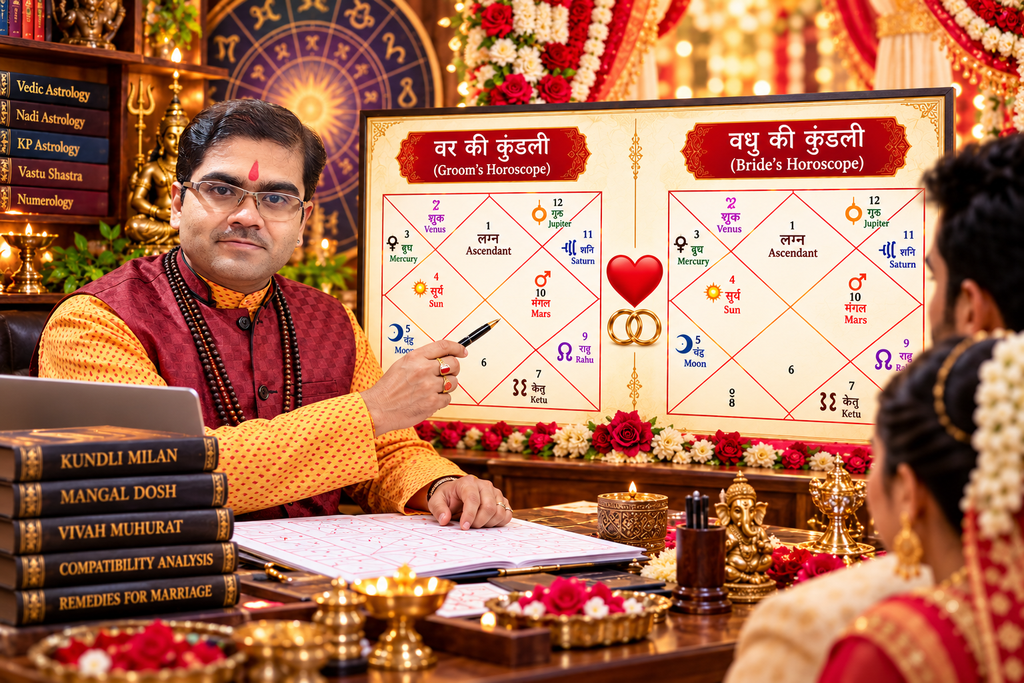
In Vedic astrology (Jyotish), evaluating marriage compatibility has traditionally relied on Ashtakoot Guna Milan, a 36-point scoring system calculated from the birth Moons of the prospective couple. In popular matchmaking, obtaining a score of 18 or higher—representing the 50% threshold—is frequently celebrated as an automatic green light for marriage.
However, relying exclusively on an automated Guna score creates major analytical blind spots. In Nadi Jyotisha all these kuta is not important, In Nadi Venus is the main Karaka of Marriage for male & Mars for Female. If in both Male & Female chart VENUS & MARS ARE 6/8 POSITION FROM EACH OTHER, Both Ascendent / Lagna & lagna lord are 6/8 position from each other, also venus and mars having connected with RAHU/KETU/SHANI/ SUN and connected with 1,6, 10 then Marriage life will be worst.
To evaluate true compatibility, an experienced astrologer looks far beyond surface-level numbers to analyze cancellation mechanics (Parihara), structural chart factors, divisional charts (Navamsha), malefic balancing (Papa Samya), and planetary period timing (Dasha Sandhi).
1. The Ashtakoot System & Its Structural Limits
The Ashtakoot Guna Milan system evaluates compatibility across eight specific dimensions (koots or kootas), adding up to a total of 36 points:
| Koota | Maximum Points | Astrological Basis | Dimension Evaluated |
|---|---|---|---|
| Varna | 1 Point | Lunar Sign Category | Spiritual alignment, ego structure, and working temperament. |
| Vashya | 2 Points | Lunar Nature Groups | Mutual attraction, emotional influence, and relationship balance. |
| Tara | 3 Points | Distance between Nakshatras | Health, longevity, and mutual rhythm of wellbeing. |
| Yoni | 4 Points | Nakshatra Animal Archetypes | Instinctive affinity, biological attraction, and physical intimacy. |
| Graha Maitri | 5 Points | Friendship of Moon Sign Lords | Intellectual rapport, communication, and mental friendship. |
| Gana | 6 Points | Temperamental Archetype | Behavioral nature, coping mechanisms, and social outlook. |
| Bhakoot | 7 Points | Relative Moon Sign Geometry | Family prosperity, financial stability, and emotional depth. |
| Nadi | 8 Points | Subtle Energy Channels | Genetic compatibility, physiological health, and progeny. |
Why the 36-Point Score Is Incomplete
- Evaluates Only the Mind (Chitta): Because the entire 36-point matrix is generated solely from the Moon’s longitude at birth, it reflects only emotional habits and psychological alignment. It completely omits the Ascendant (Lagna), which governs physical vitality; the 7th house, which rules the marital contract; the 8th house, which governs marital longevity; and the planetary periods (Dashas), which govern timing.
- Heavy Top-Weighting: Nadi Koota (8 points) and Bhakoot Koota (7 points) together account for 15 out of 36 points (over 41%). A mismatch in these two factors alone immediately drops a couple’s score to 21 or lower, triggering automated software warnings even if intellectual (Graha Maitri), temperamental (Gana), and physical (Yoni) compatibility score perfectly.
2. Deconstructing the “Big Three” Doshas
When Ashtakoot scoring yields zero points in critical categories, astrological flags known as Doshas are triggered.
Nadi Dosha: Constitutional & Genetic Harmony
Formed when both partners share the same Nadi assignment (Adi, Madhya, or Antya), Nadi Dosha results in 0 out of 8 points. In Vedic astrology, Nadi correlates with the Ayurvedic tri-dosha constitutions (Vata, Pitta, and Kapha). Sharing the same constitutional channel can indicate subtle physical disharmony, reduced vitality, or challenges regarding progeny.
- Adi Nadi: Associated with nervous system friction, emotional distance, and health sensitivity.
- Madhya Nadi: Classically considered the most critical, linked to emotional volatility, metabolic heat, and acute stress.
- Antya Nadi: Associated with metabolic imbalances, emotional coldness, and progeny delays.
Bhakoot Dosha: Relational Geometry
Bhakoot Dosha occurs when the Moon signs occupy geometrically strained house intervals from each other, scoring 0 out of 7 points:
- 6/8 Position (Shadashtak): Considered the strongest Bhakoot flaw, associated with conflict, health crises, and sudden disputes.
- 2/12 Position (Dwir-Dwadash): Linked to financial imbalance, high expenses, and economic strain.
- 5/9 Position (Nav-Pancham): The mildest pattern, associated with delays regarding children or differing life philosophies.
Mangal (Kuja) Dosha: The “Outside the Score” Variable
Crucially, Mangal Dosha does NOT form part of the 36-point Ashtakoot score. It is an independent condition caused by Mars (Mangal) occupying the 1st, 2nd, 4th, 7th, 8th, or 12th house from the Lagna, Moon, or Venus.
Mars governs drive, aggression, and physical energy. Posited in domestic or marriage houses, Mars can introduce volatility and temperamental clashes. Because automated Guna Milan calculators ignore house placements, a couple can register a glowing score of 32/36 while harboring an uncancelled, severe Mangal Dosha.
3. Classical Cancellation Mechanics (Parihara)
Treating a raw Dosha flag as an immediate deal-breaker is a frequent error. Classical scriptures provide explicit cancellation rules (Parihara) where negative impacts are neutralized:
- Nadi Dosha Cancellations:
- Both partners share the same Nakshatra but occupy different Padas (quarters), mapping to distinct Navamsha signs.
- Both share the same Nadi but fall into different Moon signs (Rashis).
- Both Moon signs share the same ruling planet (e.g., Aries and Scorpio, both ruled by Mars).
- A strong benefic planet (like Jupiter or Venus) casts an aspect on the 7th house from the natal Moon.
- Bhakoot Dosha Cancellations:
- The Moon signs share the same ruling planet (e.g., Aries-Scorpio 6/8 ruled by Mars, or Taurus-Libra 2/12 ruled by Venus).
- Sign rulers are natural friends (e.g., Sun and Mars) or the match achieves a full 5/5 score in Graha Maitri Koota.
- Rashi lords occupy mutual Kendra (1st, 4th, 7th, 10th) or Trikona (1st, 5th, 9th) houses.
4. What Expert Astrologers Check Beyond Guna Milan
To determine long-term marital bliss and stability, professional astrologers execute a comprehensive diagnostic process:
1. Analysis of the 7th House & Navamsha (D9) Chart
While the natal (Rashi or D1) chart shows external desires, the Navamsha (D9) divisional chart reveals the inner reality and long-term fruition of marriage.
- 7th Lord Strength: A 7th lord placed in favorable Kendra or Trikona houses brings stability, whereas placement in Dusthanas (6th, 8th, or 12th) or being hemmed between malefics (Papakartari Yoga) points to delays or conflict.
- Relationship Karakas: Venus (Shukra) represents relationships in all charts, while Jupiter (Guru) is essential for domestic harmony.
- D9 Redemption: An exalted or well-placed planet in the 7th house of the Navamsha chart can redeem a troubled D1 chart, indicating lasting marital harmony.
2. Papa Samya: Malefic Point Balancing
Papa Samya (or Dosha Samya) is the quantitative calculation of malefic planetary content across both charts. If one partner carries a heavy malefic burden, the other partner must possess a comparable malefic load to maintain equilibrium.
Malefic points are assessed for Mars (2.0 pts), Saturn (1.0 pt), Rahu (1.0 pt), Ketu (0.5 pt), and Sun (0.5 pt) across the 1st, 2nd, 4th, 7th, 8th, and 12th houses from Lagna, Moon, and Venus. Ideally, the prospective groom’s malefic points should be equal to or slightly higher than the prospective bride’s.
3. Dasha Timing & Dasha Sandhi
A match may appear compatible on paper, but its survival depends on the operating Vimshottari Dashas. Operating periods must activate supportive houses (1st, 2nd, 5th, 7th, 9th, 11th) rather than destructive ones (6th, 8th, 12th).
Special care is given to Dasha Sandhi—the transition period when a person finishes one major Mahadasha and shifts into another (e.g., Rahu to Jupiter). If both partners undergo Dasha Sandhi simultaneously, the compounded emotional and psychological volatility can severely strain the early years of marriage.
4. KP Cusp Sub-Lord Verification
Advanced astrologers utilize Krishnamurti Paddhati (KP) techniques to verify whether marriage is promised. Under KP rules, if the 7th Cusp Sub-Lord (CSL) signifies houses 2 (family), 7 (marriage), or 11 (desire fulfillment), the union is promised and enduring. Conversely, if it signifies separation houses (1, 6, or 10), the union faces severe strain regardless of a high Ashtakoot score.
Conclusion: A Holistic Approach to Kundli Matching
A Guna Milan score of 18+ is merely a helpful first filter—not a final verdict. True compatibility requires evaluating classical cancellation rules, analyzing 7th house lords, balancing malefic loads through Papa Samya, and checking operating Dashas.
By moving beyond automated calculators and consulting a professional astrologer for a complete chart analysis, couples can gain genuine clarity and build a grounded, harmonious, and enduring marriage.
 Planning a Kundli Matching or Marriage Consultation? Get a complete, personalized 1:1 horoscope compatibility report examining your D1, Navamsha (D9), Papa Samya, and Dasha cycles . Click the button below.